We Asked a Generic AI Chatbot and Sinoa the Question Every Producer Asks in August.
One Gave a Price. The Other Gave a Homework Assignment.
Would you rather get grain marketing advice from someone who sounds confident, or someone who actually knows?
Picture asking two people the same question about pricing your grain.
The first has some general market knowledge, and they’ll give you an answer, smooth, confident-sounding. But push a little, and you realize they’re filling in the gaps. They don’t actually know your basis, your bushels, or what’s really happening in your market. They’re guessing well.
The second has spent years in it. They know the numbers because they’ve tracked them. When they’re not sure about something, they say so, and then they still give you a real, usable answer, because they have the experience to reason through the gap.
That’s the real difference between generic AI and specialized AI like Sinoa.
Sinoa is grain-trained on over 20 years of historical data from multiple proprietary sources. Sinoa doesn’t guess confidently to sound useful, it reasons like someone who’s actually done this, because it’s built on the record of someone who has.
So we tried it on a question that has no answer on the internet. Not a market quote, not a futures settlement, not something you can look up. A question that depends entirely on the farm asking it:
“What do I need to get for canola this year to actually make money?”
That’s it. No cost figures, no yield estimate, no acres. Exactly the way a producer might type it. We put it to both tools, and this time the answers didn’t look similar at all.
Same question, same day, to both tools, with no additional prompting or follow-up.
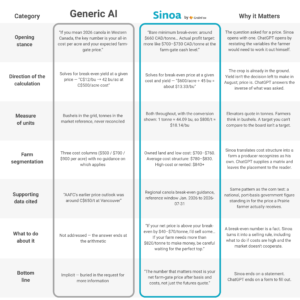
The generic AI did the math correctly. It built a break-even table showing what yield you’d need to cover $500, $700, or $900 per acre at canola prices from $12 to $15 a bushel. It correctly noted those were break-even yields rather than profit targets, and explained how to add a profit margin on top.
Then it stopped and asked for seven pieces of information: province and area, canola acres, expected yield, fertilizer cost, chemical and seed cost, land cost or cash rent, machinery and custom work, and the current elevator bid. With those, it said, it could calculate an actual break-even.
There were two problems.
The first is direction. The farmer asked what price he needs. The grid solves for yield; how much he’d have to grow to cover his costs at a given price. In August, with the crop already in the ground, yield isn’t the variable he controls. Price is.
The second is the close. The answer ends by handing the original question back to the user, this time as a seven-item list. The one supporting number it did offer was Agriculture and Agri-Food Canada’s outlook of roughly $650 per tonne at Vancouver, which is a national, port-basis figure, not the price showing up on your local elevator’s bid sheet.
Sinoa flagged upfront that it couldn’t access current local cash bids and said what it would use instead. Then it named prices.
A bare-minimum breakeven near $660 per tonne against recent benchmark costs. A real profit target closer to $700–$730 at the farm gate. For a farm carrying an average Prairie cost structure, $780–$830. For high-cost operations or rented land, $840 or better before canola genuinely pays.
It gave the same formula the generic AI used; total cost per acre divided by expected yield, but ran it in the direction the farmer asked, with worked examples at $600 and $700 per acre against 45- and 50-bushel yields. It converted every target into both units, showing the math: one tonne is about 44.09 bushels, so $800 per tonne is about $18.14 per bushel.
And it closed with what to do about it. Sell some when the net price clears break-even by $40–$70 per tonne. Price a meaningful portion in the $800–$830 range. Above $840, don’t leave much unpriced. And if your farm needs more than $820 just to break even, use rallies to protect margin rather than waiting for a top that may not come.
Why this matters more than it looks
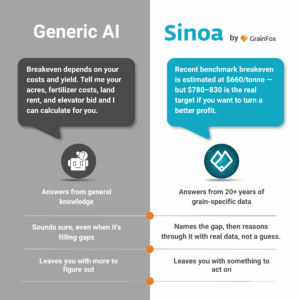
The generic AI’s answer isn’t wrong. The grid is correct, the caveats are fair, and the request for farm inputs is a reasonable thing for an analyst to ask.
That’s the point. It’s a competent answer from something that doesn’t know the farm, and it’s one conversation away from being useful. The conversation just never happens. Most producers won’t come back with fertilizer costs, cash rent, and machinery expense itemized. They asked the question in eleven words because they wanted an answer now.
Sinoa knows the operation it’s talking to. So instead of asking, it answered, and then connected the number to a decision about when to sell.
What the gap is worth
It’s fair to ask whether this distinction matters in practice, since one of these tools is free to use. But look at what each answer actually leaves a producer able to do. Sinoa’s answer ends with a window to act in: price meaningfully in the $800–$830 range, don’t leave much unpriced above $840. The generic AI’s answer ends with a seven-item list and no window at all.
Run that against what’s actually at stake. If a producer growing a mid-size 1,000-tonne canola crop misses that $800–$830 window by even $20 a tonne because the number never resolved into something they could act on, that’s $20,000 left on the table in a single season, on one crop, in one year. That’s the practical cost of an answer that never became a decision.
A producer can eventually do this math themselves: work out the actual costs, plug them into the generic AI’s table, and invert it back into a price. But by the time that homework is finished, the market that mattered when the question was first asked may have moved. Sinoa skips the homework because it already knows the farm it’s talking to.
That’s also where the rest of the platform keeps working on it. Aside from Sinoa, GrainFox has a library of farm wealth tools, including Scenario Planner which is built for testing yield, price, and cost scenarios against break-even and covers exactly the exercise this question calls for.
And once a target exists, Smart Advisor takes it from a one-time number to an ongoing plan. Set up takes less than ten minutes and gives you an ongoing playbook you can use to make decisions quickly. Smart Advisor’s Action Plan lays out what percentage to sell over a two-month decision period. The Best Action Plan in Smart Advisor provides short-term price predictions and identifies the optimal day to sell if a sale is recommended. It also shows a 2 Month Price Prediction based on historical data, current market trends, Barchart Solutions, and other reliable data sources. And to help you understand the reasoning behind Smart Advisor’s sales recommendations, the Sinoa Analysis section explains, in plain terms, what’s actually driving the recommendation based on your farm details. The plan doesn’t just say what to do, it says why.
The key takeaway: Both tools can do the math, and neither has a monopoly on financial literacy (the formula is the same in both answers). The difference is that one of them knows the farm it’s talking to. Asked a question with no public answer, the generic AI solved the wrong variable, cited a national port-basis figure, and closed by requesting seven inputs the farmer didn’t have on hand. Sinoa was upfront about the data it was missing, then gave a price, in both units, matched to the operation, with a rule for when to sell against it. The gap isn’t the math. It’s whether the tool has general market knowledge or is an expert in their field.